Software defines the service.
Provisioned in code, assured by telemetry, resolved by agents. The operating model stops being a diagram on a wall and becomes a product you ship.
Two decades on both sides of the managed services table, around 300 people, and one argument about what comes next: software defines the service, AI runs the routine, and people are why customers choose yours.
This site is where I work that out in public. The argument, the record behind it, the product it became, and the places where it breaks.
Shift left wasn't wrong. When every fix cost an hour of somebody's time, pushing work towards cheaper resolution was sensible arithmetic. AI is changing the arithmetic, so the question changes too. Not how to keep people away from demand. Where they belong in it.
The Human Operating Model is that answer, written down. Not a framework you can get certified in. An argument about how services get designed, sold, delivered and led when software does the running.
Read the manifestoProvisioned in code, assured by telemetry, resolved by agents. The operating model stops being a diagram on a wall and becomes a product you ship.
If a machine can sense it, decide it or fix it within policy, it should, before anyone has to ask. Every provider is about to get equally good at the boring bits.
Competence used to be the pitch. Now it's the floor, and the floor is free. Put people where the dread, judgement and consequences are. Not on the password resets.
So, for each one: what I owned, what I decided to do about it, and what moved as a result. A number without the move behind it is just scope.
The fuller version, for boards, investors and search →Customer NPS in year one, alongside 20% services growth. Five functions were duplicating each other's effort on five systems of working. I designed one delivery operating model to replace them, with a digital operations spine underneath and career pathways built alongside. Then wrote the business case and board paper for the AI and automation platform that carries it forward.
Margin, while cost was coming out of the business. Two moves. Operational cost came down through a shoring programme into a growing Indian capability. And the technical service managers were rebuilt from reactive cover into customer success, owning commercial growth of the portfolio. In 2017, before the label caught on. TRI*M held above 90 throughout.
Services revenue over the period. An 800-person managed services acquisition had to become one business rather than two sharing a logo. I designed how they'd integrate across people, process and tooling. The same move as the Softcat framework, a decade earlier.
Employee satisfaction in six months, to 86, owning a global IT estate end to end as the customer. Purpose first, a simpler operating model, then intentional attrition and better recruitment. Being on the receiving end of an SLA teaches you things about your own industry you'd rather not know.
I write the board papers. I also ship the software.
Six working modules and an operating model that writes itself from your numbers. Built, on sale, and module one is open to everyone.
A tool that shows people where their career could go next and what it takes to get there. Built with AI agents by a small group, now used across the business.
I still couldn't explain to you what a class is. The point isn't the code. It's knowing what the tools can do before the business case is written.
Every model breaks somewhere, and I'd rather find the holes before you do. Each claim has a known way of going wrong. These are the ones I'm working on, labelled by how much I can actually prove: idea, being tested, evidence or open question.
…a contact that never reaches a person gets booked as a saving, whether the problem was fixed or the customer gave up. Same tick. Different customer. And now the customer has an agent that never gets bored.
Outside IT, so far. Citizens Advice, September 2026: four in ten people trying to sort out an essential bill found it hard or impossible to reach a human. Fourteen per cent of those gave up.
Read the argument →…AI takes the routine work that used to teach people judgement. You save the bottom rungs and lose the climb. Lisanne Bainbridge called it an irony of automation. In 1983.
Outside IT, so far. Bastani and colleagues, PNAS 2025: with GPT-4, students' practice grades rose 48%. Once it was taken away, they scored 17% lower than students who never had it.
Read the argument →…prevention removes the work that pays for it. If a provider is paid for activity, the best line on the invoice is the one that pays nothing. The tickets went down, so why didn't the bill? I've asked that question as the customer. The answer was a slide.
The pricing has to be ready before the renewal meeting. Nobody has a clean answer yet. Mine included.
Got one? Tell me →Six working modules that produce the three numbers almost no service report contains: failure demand, flow efficiency, and the lead time your work in progress makes inevitable. They assemble into one operating model, with the diagnosis, the first ninety days and a board case built from your figures rather than mine.
I built it because an operating model I argue for on stage had to exist as software, or the argument was only ever a slide.
£295including VAT, once. No renewal.
One named person and one organisation, up to five authorised devices at once, nothing to install. Working for clients? One licence per client. Fourteen days to change your mind.
Module one needs no key and no email. The full kit is one licence, no tiers: if a colleague wants one, that is a second licence rather than a negotiation. The complete worked example · What Shift Right is →
Northwind Managed Services · a fictional provider, assembled from all six modules
Every number computed by the kit, and every one reconciles. Yours will differ, and that is the point.
18,000 people read it there first. A month later, the pieces that survived the comments come here.
That's a lot of revenue, and a lot of service numbers, resting on people running out of patience. And patience is about to be free.
Mark BoyerSignal · 13 Oct 2026The portal's not the product.When the customer can ask their own question of their own data, the forty-slide pack isn't what they're paying for. What's left to sell is whether the numbers are right.
Mark BoyerSignal · 14 Oct 2026Crypto's got a bunker. Most companies haven't got a list.The locks need swapping by 2035. Working out where they all are is due by 2028, and that's the hard deadline, because almost nobody has a list.
Mark BoyerField note · 15 Oct 2026No camera looks exactly like a hidden one.Trust has to be visible to the person who didn't buy it, or it doesn't count. Even Realities took the camera out. Making that obvious might be the harder design job.
Mark BoyerArgument · 8 Sep 2026Nobody grows in a job they're already good at.It isn't a jobs problem. It's a reps problem, and you can design the reps back in.
Mark BoyerArgument · SITS 26 keynoteWhy the industry that manages change can't handle it.ITSM has become brilliantly organised at describing yesterday. We mistake legibility to ourselves for value to our customers.
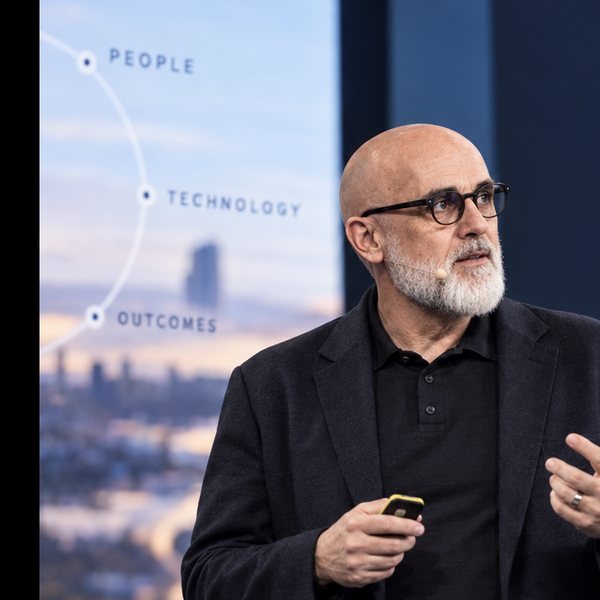
"As masterful as ever. He owned that stage. Not just the brilliant material, but a genuine public speaking masterclass."Audience reaction · SITS 26, main stage
Main stages at SITS 26, SDI Spark 26, itSMF UK and PropelX London, and the boardrooms after them. Keynotes, panels and workshops, when the room is right. Fewer of them than last year, chosen more carefully.
It's the page written for you: what I owned, what I decided, what moved. The CV follows on request, conversations are held in confidence, and you'll get a reply within 48 hours.