Mark Boyer
About · a profile, not a CV

Joining the dots between strategy, executionand how people actually work.

Global Services Director at Softcat, accountable for a £600M services portfolio and around 300 people. Two decades on both sides of the managed services table, and one question I've never managed to leave alone: why do technically excellent services still leave people frustrated?

I write about it, and I'll argue it from a stage. The day job is running it.

Mark Boyer
01 · The story

Two decades on the inside.

I've spent over two decades in IT services: the UK, the Nordics, Spain, Eastern Europe, South America, India and New Zealand, with large providers like SCC, CDW and T-Systems, and now at Softcat as Global Services Director.

That's put me on the inside of how technology services actually get sold, designed, built, run and improved, across global enterprise, regulated industries, mid-market and public sector. Operational rather than theoretical. Commercial rather than abstract.

That sounds like a career summary. It isn't meant to be.

What those years actually taught me is that this industry built an entire profession around the assumption that better processes produce better outcomes, then spent decades wondering why technically excellent services still leave people frustrated, confused or ignored.

That question led me into behavioural science, design thinking, customer journey mapping and value stream analysis. Not as frameworks to adopt wholesale, but as lenses that sharpen how you think about a service. Rory Sutherland's work has had more influence on me than most of the industry's, particularly his argument that conventional logic, applied to human problems, consistently produces the wrong answer.

I sit at the intersection of strategy and execution. I care about making sure what an organisation says, what it sells and what it can genuinely deliver all line up.

That thinking now has a name, the Human Operating Model, and an argument of its own: software defines the service, humans differentiate it, shift right. Read it in full.

Mark Boyer speaking at Softcat's Partner Forum 2025
Partner Forum 2025 · the delivery partners, in one room.
02 · The record

Both sides of the table.

I've run managed services at scale, and I've been the customer holding providers to account. Very few people in this industry have done both. What follows isn't a list of jobs. It's what I owned, what I decided to do about it, and what changed as a result.

The fuller version, for boards, investors and search →
SoftcatGlobal Services Director · 2025 to present

Accountable for a £600M services portfolio and around 300 people across five service functions. Designed the Unified Services Framework, Softcat's global delivery operating model. It took the duplicated effort out from between the five functions, put a digital operations spine underneath them, and gave the business one system of working instead of five. Career pathways were built alongside it, so people could see a route through the new model rather than just a new process. Year one: 20% services growth, customer NPS to 68, and 80+ delivery partners orchestrated through a single model. Wrote the business case and board paper for the AI and automation platform behind the next generation of those services.

CDWHead of Services, Kelway (now CDW UK)

Designed how an 800-person managed services acquisition would integrate into the business, across people, process and tooling, and built the UK Service Operations Centre from a clean sheet. The same design and build move as the Unified Services Framework, a decade earlier. Services revenue grew from £50M to £250M over the period.

T-SystemsHead of Service Management, Northern Europe

Ran a £250M Northern Europe portfolio and grew margin by more than 20% while cost was coming out of the business. Two moves did that. Operational cost came down through a shoring programme, moving delivery from Eastern Europe into a growing Indian capability. And the Technical Service Manager role was rebuilt from reactive operational cover into customer success, owning the commercial growth of the portfolio offerings. That was 2017, before the industry had agreed on the label. PCI-DSS operational accountability across global hospitality and energy estates.

The WorkshopGlobal IT & service operations · the customer side

Owned a global IT estate end to end as the customer: 170+ services, 1,000+ endpoints across Windows, macOS and Linux, distributed teams across five countries and four time zones, from physical data centres up through private cloud. Employee satisfaction rose 50 points in six months, to 86. That came from defining what the function was actually for, simplifying the operating model, refining how the work flowed through it, and being deliberate about who was in the team. Dan Pink's three, purpose, mastery and autonomy, first. Then intentional attrition and better recruitment.

EarlierSCC · Bidvest 3663

Service leadership at SCC, and holding national MSPs to account on behalf of a multi-site foodservice business: the years that taught me what being on the receiving end of an SLA actually feels like.

03 · What I believe

Six things I'd bet on.

i

The IT services industry needs to move beyond procedural thinking and towards something more thoughtful, more human, more creative and more effective.

ii

Brilliance in the service desk is often evidence of failure in the service: exceptional people buffering users from things that were never designed to be easy to live with.

iii

Frameworks should be foundations, not prisons. Quoting ITIL in a boardroom is like quoting the Highway Code on a first date. Technically correct, deeply unattractive.

iv

Feelings aren't a side effect of service delivery. They're the product. Until we design for how people actually think, feel and behave, we'll keep building services that work on paper and fail in practice.

v

The next great idea for IT services won't come from IT services. It'll come from art, from design, from psychology, from culture.

vi

If we can't change our own profession, we've no business claiming we know how to lead change for anyone else.

04 · How I lead

Servant leadership. High standards.

My leadership is rooted in servant leadership, with high standards. I care about creating the conditions for people to do their best work, building high-performing teams, and the kind of environment people choose to stay in. And I value candour, accountability and challenge, because the best teams aren't built on comfort alone.

In the day job I lead a service operations organisation that works with thousands of customers across every sector. The arguments on this site come from that work. They aren't hypothetical.

I don't see myself as a custodian of the status quo. I want substance over appearance, clear thinking over fashionable language, and honest conversations over easy consensus. The four principles I lead by, and what people who worked for me say about them, are on the record.

05 · Beyond the day job

Arsenal, and the honest measurement of lap time.

Outside work I'm an Arsenal supporter, which means I understand both the value of patience and the danger of assuming past performance guarantees future results.

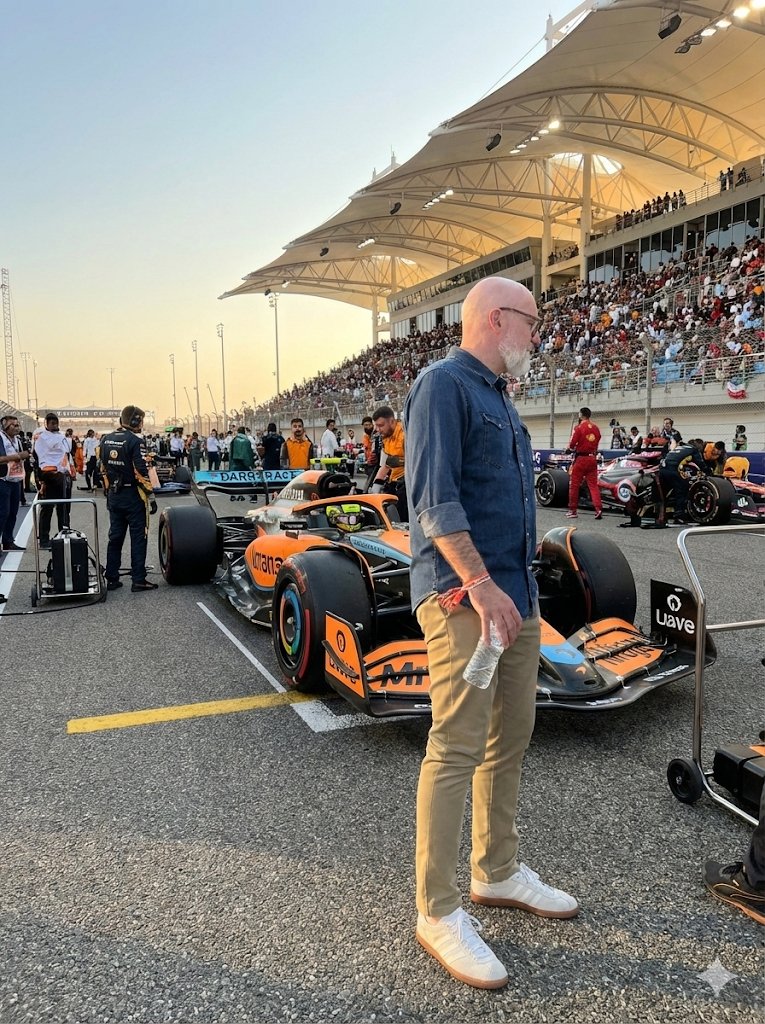
I'm also a devoted Formula 1 obsessive. There's a lot of overlap between the operational discipline of a paddock and the operating model of a service organisation. Tight feedback loops. Continuous tuning. The honest measurement of what actually moves the lap time, versus what just looks good on the dashboard.

Mark Boyer on the grid at the Bahrain Grand Prix
Off the clock · on the grid, race week, Bahrain.
Get in touch

Want to talk?

Whether it's about the work, the argument, or what comes next for services, I'm glad to hear from people thinking about the same problems.