How many ITSM leaders sit at the very top table?
IT service management, ITSM, sits at the heart of how modern businesses run. But how many of us actually see ITSM leaders sitting at the very top table? Why is it so rare to see one of us in the C-suite?
This is not going to be a fluffy session. I am not here to convince you that ITIL 4 is the missing link to the boardroom. Spoiler alert: it is not. We keep the lights on. We protect the data. We enable everything else to work. And yet, when the company publishes its annual report, we are not in the photos. We are not quoted in the strategy. We are the backbone, but rarely the face.
And before anyone asks the obvious, yes, I am standing here talking about the C-suite despite not being in it myself. That is kind of the point. I have spent my career working across both sides of the fence. Large service providers. Now Softcat, in my humble opinion, the biggest and the best. I have worked across the UK, the Nordics, Spain, Eastern Europe, South America, India, New Zealand. The story is the same wherever I have gone.
At Softcat we work with ten thousand customers. That gives us a unique view into what works, what does not, and how service management plays out across almost every sector. Our CTO came from ITSM, proof it can be done. He nearly ruined this talk topic by existing.
I am not here to tell you how I made it. I am here to share why so few do, and what we can do about it.
The six reasons we do not get invited upstairs
I think there are six big reasons. Six habits, or perceptions, that hold us back. All of them are fixable.
01, Branding. We look like the process police
Too many of us look and sound like the process police. When I first got into service management, I thought being the most thorough person in the room made me valuable. It did, until I realised people did not invite me to innovation meetings because they assumed I would say no.
We live for CAB meetings. We find joy in saying "no." We wear our change governance badges with pride like they are medals of honour. But to the rest of the business, we are the people who slow things down. If you want to be seen as the next CEO, that is not the brand you want.
Personal branding matters. Not the influencer kind, not "look at my LinkedIn post with a sunset emoji." Real branding. The kind that shapes how people experience you when you are not in the room. Ask yourself: what three words do people associate with you? Dependable? Safe? Detailed? Good, but none of those get you into the boardroom. What about strategic, commercial, creative? That is where the game changes.
02, Language. We speak ITIL, not business
Ever tried explaining SLAs to a CFO? It is like reading IKEA instructions to your dog. Lots of staring. No comprehension. The moment I stopped talking about incidents and started talking about customer continuity, the CFO leaned forward for the first time in months.
I once saw someone walk a board through their "Incident SLA Compliance Dashboard." The CFO's face looked like they were being read the rules of Monopoly backwards.
We have got to learn the language of business. When you talk about "incident response," translate it to "revenue protection." When you say "availability," make it "customer uptime." Talk in outcomes, not operations. Branding at a professional level is translation. Code-switching between IT and business fluently. If we do not translate, we isolate.
03, Ambition. We act as guardians, not challengers
We are brilliant guardians. We defend the system, protect the process, and make sure nothing blows up. But guardians do not get promoted to CEO. When was the last time you saw Gandalf as a CFO?
That is the problem. We have been trained to protect, not provoke. We have made safety a habit. And habits can be handbrakes. Great leaders are not just guardians. They are challengers. They ask "what if we did this differently?" even when it makes people uncomfortable. Too many of us in ITSM have been trained not to challenge. We are told to follow the process, stick to the framework, keep things safe. But safety rarely creates growth. Courage does.
04, Value. We forget who the real customer is
We keep saying our colleagues are our customers. That is wrong. The real customers are the people paying the bills.
Gartner's 2025 CIO report said 74% of IT leaders still measure success by uptime, not by business impact. That is not leadership. That is logistics. If Amazon thought its customer was the warehouse staff, it would be out of business.
When we only look inward, we forget the why behind everything we do. ITSM has to connect directly to business value, to how customers experience us, how revenue is protected, how reputation is maintained. That is the language the C-suite speaks.
05, Failure. Tickets closed, not failures prevented
We celebrate tickets closed like they are trophies. "I closed 1,200 tickets this month!" Great. You have got world-class problems.
We measure how quickly we respond to failure, not how effectively we prevent it. Imagine a doctor proudly saying, "Don't worry, I can fix a heart attack in under fifteen minutes." Maybe just… do not cause one.
If ITSM is the art of stability, our measure of success should be resilience, not speed of reaction. Start building services to avoid failure, not for failure. That means designing systems that anticipate problems, automate resolution, and learn continuously. Design thinking, service blueprinting, AIOps. They are not buzzwords. They are our chance to step up. The teams that succeed do not just fix faster. They fail less.
06, Relationships. Wrong room, wrong conversations
We build great relationships with finance, compliance, audit. The departments that love structure as much as we do. Nobody ever got promoted for being best friends with compliance. It is like being popular in detention.
The real unlock for me came when I started spending time with sales and marketing. Suddenly I was hearing the customer story first-hand. It changed everything about how I led my teams.
If you want influence, build those relationships with sales, marketing, product. The people driving growth. When you start understanding their goals, their customers, their metrics, suddenly you are in the conversations that matter. That is when ITSM stops being background noise and starts being business critical.
ITSM is already a leadership discipline
Here is the truth. ITSM is already a leadership discipline. We already have the skills the C-suite uses every day. We just do not market them that way.
Stakeholder management. This is not about ticket queues or governance forums. It is about people. And people are gloriously unpredictable. I have sat in stakeholder meetings where the same incident was called a disaster, a learning opportunity, and a minor inconvenience, all in the same breath. You learn fast that influence is not about process. It is about psychology. Half of what we do is political negotiation disguised as service governance. We do not manage incidents. We manage expectations. We do not run reports. We translate emotion into action. That is the same skill set the C-suite uses every day. Except we do not get the executive coaching. We get the 9 a.m. service review.
Risk and resilience. CFOs talk about financial risk. CMOs talk about brand risk. We live in operational risk every single day. Every patch window, every upgrade, every supplier dependency. It is a live experiment in balancing risk and reward. The rest of the business writes continuity plans. We live continuity plans. When ransomware hits or the network falls over, nobody calls HR. They call us. The board pays consultants a fortune for "resilience frameworks." We have been doing it for years. We just never called it that.
Customer experience. Before CX became an acronym plastered across LinkedIn, ITSM had already mastered it. The service desk was the original front line of customer experience. Except we did not call it experience. We called it first contact resolution. We reduced emotion to a metric, and lost the story. Think about what really happens on a good service desk call. Someone arrives frustrated, stuck, maybe even angry. And within a few minutes, through empathy, reassurance, and skill, we turn that frustration into relief. That is experience design. That is emotional intelligence. That is leadership.
Navigating complexity. If you have ever run a service contract with ten suppliers, fifteen systems, and one customer screaming for simplicity, you have already done portfolio management, supply-chain governance, and executive-level problem solving. Half the time, ITSM is basically the art of orchestrating chaos. We sit at the intersection of people, process, partners, and politics, and somehow we still make it work. That is not operational discipline. That is systems thinking. That is holistic leadership.
While we have mastered governance, business has mastered design
If we stop there, we are still playing the same game. We are proving we can lead, but not showing how we will lead next.
The world around us is not slowing down to admire our processes. While we have been mastering governance, the businesses we support have been mastering design. They are moving faster, testing ideas, iterating products, designing experiences. Meanwhile, too many ITSM teams are still running six-month improvement projects to fix a form field.
That is the gap. It is not about capability anymore. It is about creativity. Not more control. More curiosity.
Design thinking is the bridge to the boardroom
The best leaders. The ones who move from operations to the boardroom, do not just maintain systems. They design the future of how those systems serve people.
If ITSM wants a seat at the top table, we have to stop thinking like operators and start thinking like designers. Design thinking starts with a simple but powerful idea, do not start with the process. Start with the person.
For years, we have perfected the mechanics of ITSM, incident, problem, change. Policies, SLAs, templates. We have become experts in managing systems but not experiences.
The first diamond is exploration. It is where we stop asking "what is broken?" and start asking "why does this matter?" In ITSM, that means getting under the skin of the experience, not just the incident. The difference between "the printer is down" and "this is stopping a customer order from shipping." It is about talking to users, shadowing them, understanding their daily friction. The stuff no dashboard ever shows you. You cannot fix what you do not understand. For too long, we have understood systems, not people.
Then comes the second diamond, where insight turns into ideas. Where we define the real problem and design possible solutions. Where we stop asking "what process do we have?" and start asking "what experience do we want?" This is where collaboration becomes critical. Design thinking forces diversity of thought, not the same five faces in a CAB meeting. You bring in people from sales, HR, customer service, even finance. You let them co-create the solution. Because when people help design something, they are far more likely to believe in it, and to use it.
And then we build, test, iterate. We stop chasing the perfect process and start chasing the human one. Not "complete the process document." Minimum viable product. Great design does not happen in workshops. It happens in the real world. Build something small, test it fast, learn in flow.
Three questions every great service should start with
Design thinking is the bridge. The link between service delivery and strategy. Every great service, every great product, starts with three simple questions.
Desirability. Does anyone actually want this service? Will it make their life better? Feasibility. Can we realistically deliver it, at scale, reliably, sustainably? Viability. Does it make sense for the business, financially and strategically?
That is not process management. That is business design. When you think and talk like that, suddenly you are not the process police any more. You are a strategist. And strategists get invited upstairs.
At Softcat we have applied this mindset across our own services. Not as a gimmick. As a shift in perspective. We re-mapped our service blueprints around customer emotion, not process flow. We literally asked customers to draw how our service made them feel. It changed how we designed escalation paths, how we communicated, how we measured success.
That is the real power of this approach. It changes the questions we ask. Instead of "what is the SLA?" we ask "what outcome are we trying to create?" Instead of "who owns the process?" we ask "who experiences the pain?" Instead of "what do we deliver?" we ask "what do they remember?"
That is how you move from governance to guidance. From managing activity to designing outcomes. From being seen as a cost centre to being recognised as a growth enabler. Because the most strategic thing you can do in ITSM is not to build a better CAB. It is to build a better experience.
Process to product. Operational to strategic. Frameworks to fluency.
Three big shifts move ITSM professionals into leadership.
From process to product. Process thinking is about control. Product thinking is about value. In process mode we define, govern, measure. In product mode we empathise, iterate, deliver. Nobody brags in the pub about their incident management maturity. But they will happily talk about a product or service that customers actually love. We have seen teams move from "incident reduction" targets to "customer outcome" targets, and the energy changes overnight. Ownership emerges. Innovation follows. ITSM stops being the place good ideas go to die and becomes the heartbeat of innovation.
From operational to strategic. This one is about storytelling. You do not get invited upstairs to report that your MTTR went down by two minutes. You get invited to explain what that two minutes meant for customers, for brand trust, for revenue. Leaders tell stories. They do not just show data. They connect it to consequence.
From frameworks to fluency. Boards do not care about ITIL. They care about outcomes, growth, customer success. Frameworks are great. But quoting ITIL in a boardroom is like quoting the Highway Code on a first date, technically correct, but deeply unattractive. Fluency means knowing when to bend, when to adapt, when to challenge. Frameworks should be foundations, not prisons. Too many people think the bravest thing you can do is challenge a CAB. If that is your limit, you are not ready for the C-suite.
Start-ups are not building IT departments. They are building capabilities.
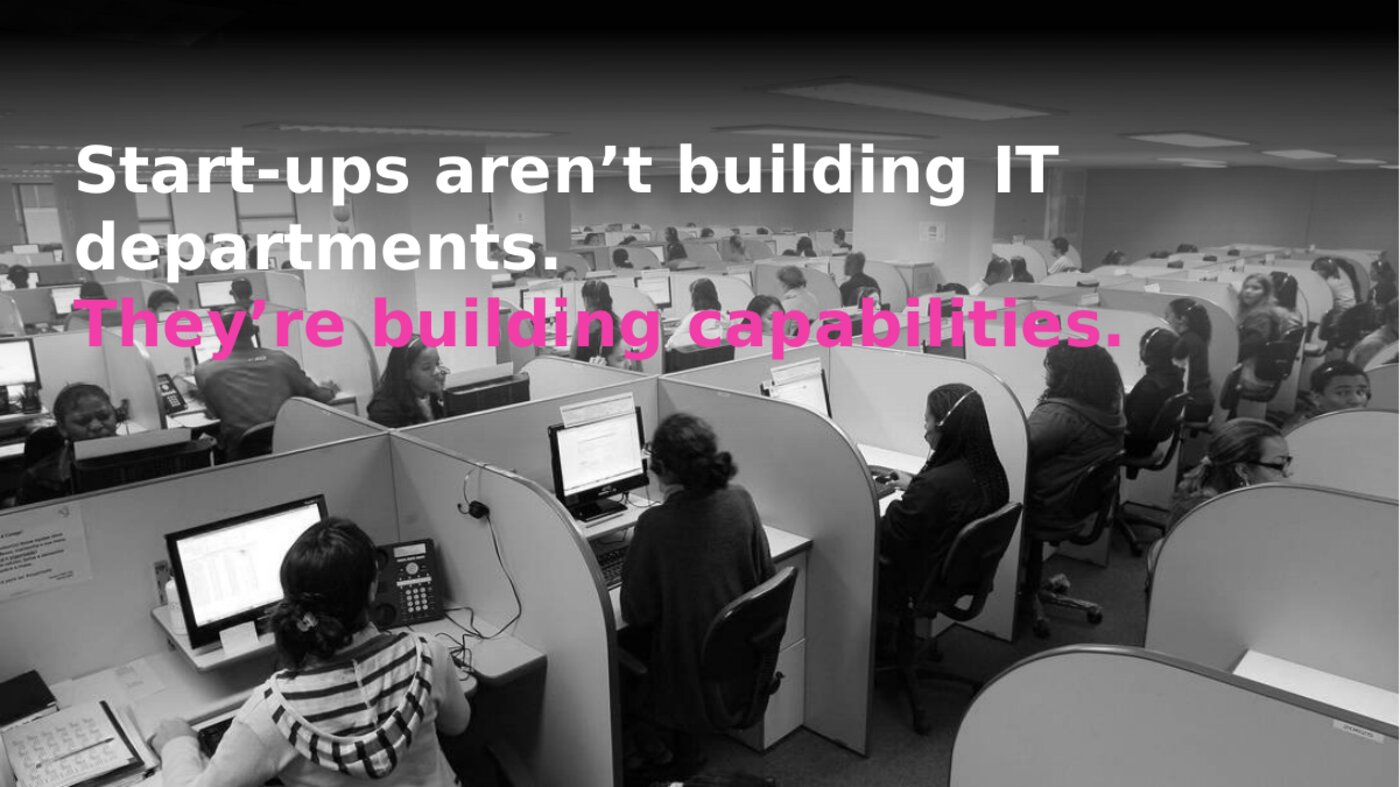
Let's zoom out. Start-ups are not building IT departments anymore. They are building capabilities.
That is the difference. They do not have "incident management." They have intelligence. They do not have "change control." They have continuous delivery. They do not build IT processes. They build feedback loops. They are built for flow, not for failure.
That should make all of us pause. Because while we have been optimising CAB meetings, they have been optimising customer moments. While we have been trying to contain risk, they have been designing for resilience.
And now, AI is about to blow the whole thing wide open. AI is not just going to change how we work. It is going to change how we are organised to work. For years we have talked about "shift left", moving problems closer to the source, empowering users, automating the basics. Shift-left has finally arrived. Only it is not a strategy any more. It is a reality.
We are entering an era of self-diagnosing, self-healing technology. Systems that fix themselves before we even know something is broken. AI agents that monitor, triage, and resolve issues faster than any Level 1 team ever could.
If your organisation is designed around failure, incidents, tickets, queues, escalations, what happens when there is nothing left to fail? What happens when your "first line" is a model, your "problem manager" is an algorithm, and your "change process" happens in real time?
You cannot build a future-proof career or organisation on reactive skills. You have to move up the stack. From fixing problems to designing systems that do not create them in the first place.
Everyone's a technologist now
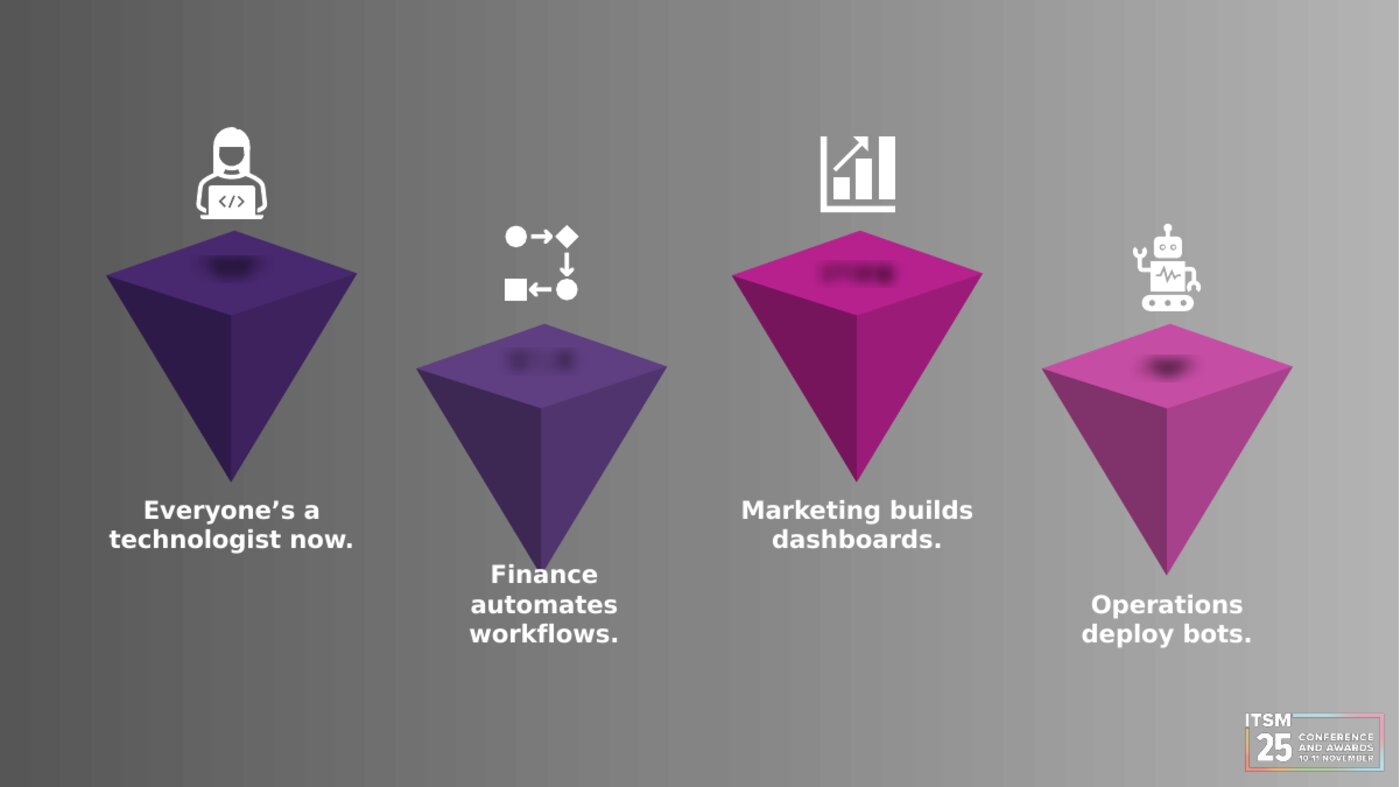
Finance automates workflows. Marketing builds dashboards. Operations deploys bots. The boundaries are gone. AI is democratising skills faster than we can regulate them. You no longer need a coding degree to automate your job. A 22-year-old with ChatGPT can design a service blueprint faster than most service managers with a decade of experience. That is both terrifying and exciting.
Because it means capability is not scarce any more. What is scarce is creativity, curiosity, and context. If that makes you defensive, it is probably a sign you have stopped being curious. This is not about losing ground. It is about changing shape. The future belongs to the people who can connect the dots, who can bring technology and humanity into the same sentence, who can turn automation into advantage.
Our competition is not the next ITSM manager down the road. It is irrelevance. But the opportunity is massive. If we can reposition ITSM as the enabler of flow, the connector between governance and innovation, the bridge between people and automation. We become indispensable. The future boardroom will still need someone who understands risk, value, and resilience. It will still need leaders who can balance control with creativity. That could be you, if you evolve faster than the frameworks.
If accountants can do it, so can we
One reason so few ITSM professionals make the C-suite is that we have boxed ourselves in. Boxed in by frameworks. Boxed in by certifications. Boxed in by the belief that credibility means quoting ITIL more fluently than the person next to us.
Frameworks matter. They give us structure, consistency, language. But they were never meant to be cages. Frameworks are like IKEA instructions, useful, sure, but if you follow them too rigidly, you end up with a wobbly chair and three leftover screws. They should be a foundation, not a prison. A starting point, not the finish line.
No one ever changed a business, let alone reached the boardroom, by sticking to the manual. Yet too often we play it safe. We follow the rules. We optimise the same processes, run the same reports, and call it innovation.
If accountants can do it, then so can we. They made spreadsheets cool. We can definitely make ITSM strategic.
Five behaviours that get you noticed
The journey does not start with a promotion or a title. It starts with behaviour.
Visibility. Speak up. Share wins and lessons, not just metrics. Do not wait for someone else to tell your story. The people who get noticed are not the loudest. They are the clearest. Language. Translate IT value into business outcomes. When you talk to finance, use their numbers. When you talk to marketing, use their customers. When you talk to the board, use their strategy. Network. Build relationships beyond IT, sales, marketing, product, finance. Every one of those functions is a classroom. Curiosity. Learn the business model, not just the toolset. Ask why, not just how. Technology keeps changing. Curiosity never goes out of date. Authenticity. Do not mimic executive behaviour. Model it your own way. People follow leaders who are real, not rehearsed.
You do not need permission to build a brand. You just need consistency, clarity, and courage. Start showing up like the leader you want to be, before anyone gives you the title. Leaders are not appointed. They are recognised.
Mark Forster started on the service desk
It can be done. Mark Forster, our Chief Technology Officer at Softcat, did not start as a CTO. He started on the service desk. Doing the same kind of work most of us in this room have done.
He did not have a fast track. He did not have a magic pass to the top table. What he had was perspective. He stopped thinking in terms of process and started thinking in terms of value. He built relationships with sales and customers. He challenged the status quo. He took risks. He connected what ITSM delivers with what the business needs.
He looked outward, not inward. He was not waiting to be invited into strategy conversations. He was already having them. Now he sits at the very top of the table, shaping the future of technology for the biggest IT provider in the UK.
From keeping the lights on, to designing the light itself
After everything we have talked about today, this is what it really comes down to. We already understand risk. We already manage resilience. We already design experience. We already live in complexity. We have every leadership skill the modern boardroom needs. We have just spent years using them to keep the lights on instead of lighting the way.
For too long, we have been building copies of ourselves, automating the same old problems, perfecting the same old processes, protecting the same old boundaries. We have become experts at replication. The future does not need replication. The future needs reinvention.
Reinvention does not come from echo chambers. It does not come from people who all look the same, think the same, validate each other on LinkedIn. It comes from new voices. From genuine diversity, not performative diversity. From people who have seen the world differently, who question the defaults we have built our careers around. Inviting more people into the echo chamber is not progress. It is just better acoustics.
Real progress comes from dissonance, from tension, challenge, curiosity. From people brave enough to ask, "why are we still doing it this way?"
Look outside our industry for inspiration. The next great idea for ITSM will not come from ITSM. It will come from art, design, psychology, culture. Be different. Be authentic. Sameness is not safety any more. It is stagnation.
So here is the challenge. Stop waiting to be invited. Stop asking for permission. Translate what you know into the language the business feels. Build relationships that drive growth. Design services that avoid failure, not just respond to it. Lead. Challenge. Influence. Because if we do not, someone else will. And ITSM will be remembered for keeping the lights on while everyone else built the future.
Make your next move count. Because if accountants can make the boardroom, so can we. And maybe, just maybe. The next innovator, the next real change-maker in ITSM, is sitting right here.